IONBOOSTER - BOOST SENSITIVITY AND IMPROVE LIMIT OF DETECTION (LOD) BY AN ORDER OF MAGNITUDE
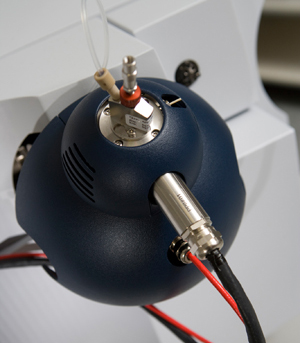
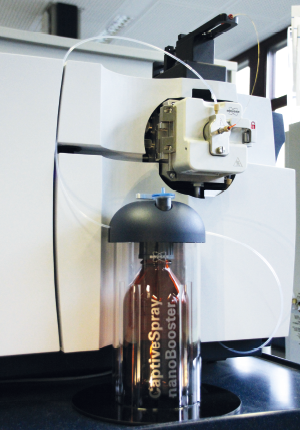
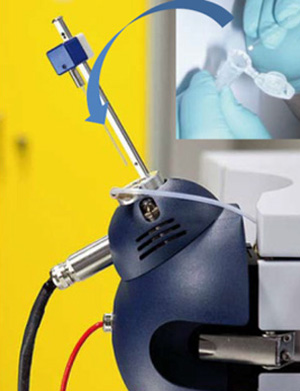
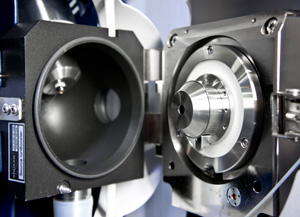
The sensitivity of the system is extremely important in most MS analytical tasks. Compared to standard electrospray, the ionBooster offers a 5–100x gain in sensitivity for many compounds of interest in the fields of environmental analysis, food testing and therapeutic drug monitoring. The ionBooster enhances sensitivity and lowers detection limits by increasing ionization efficiency in a wide range of applications. The ionBooster can be used with the latest Bruker amaZon speed, maXis, maXis impact or solariX MS systems, and is quickly and easily installed. For a wide range of compounds, the ionBooster achieves sensitivities that rival those of industry-leading QQQs, while still providing the known benefits of MSn or accurate mass values with TIP™ (True Isotopic Pattern). The ionBooster has simple operating parameters and nitrogen consumption requirements that are similar to those of conventional sources. THECNICAL DETAILS: The ion source enhances sensitivity and lowers detection limits by delivering more efficient ionization across a wide range of applications. Inside the ionBooster, an electrospray is maintained at a controlled vaporizing temperature to enable enhanced desolvation of the analyte ions, even at high eluent flow rates in UHPLC separations with sharp chromatographic peaks. The exact response with the ionBooster depends upon the type of compound and its specific chemical characteristics and thermal properties. APPLICATIONS: • ionBooster in Forensics: Ethyl-Glucuronids (EtG and EtS) are markers for alcohol misuse. The ionBooster source yields a sensitivity improvement of factor 10 for EtG, compared to a standard ESI source. For details, please refer to application note ET-28. • ionBooster in Food Safety: Extremely sensitive analytical methods are required for accurate low-level identification, and quantitation of zero-tolerance compounds in food. The broad-spectrum antibiotic Chloramphenicol (CAP) is such a compound. Determination of CAP is often performed by LC-MS/MS using MRM measurements on traditional triple-quadrupole instruments. Using the ionBooster, CAP can be determined in an LC-MS full scan method for lower limit quantification and confirmation on a maXis UHR-TOF system, without compromising other analytical information. The ionBooster achieves a Limit of Quantitation (LOQ) more than 100 times lower than the minimum required performance level (MRPL). Top: Compare Chloramphenicol signal trace of ionBooster with traditional Electrospray at 0.25 μg/kg in matrix (CAP in beef muscle). Bottom: Six replicate injections, at 0.0025 μg/kg CAP in matrix meat. Mean Signal: Noise 10:1, Peak width 3.4 sec (FWHM), Peak area RSD 9%. Figures from Application Note ET-27.
Potrebbero interessarti anche questi prodotti